Quick Enquiry

How to Evaluate MRI Machine for Long Term Clinical Performance
Why MRI system is required To reveal the interior organs, soft tissues, joints, and nervous system, MRI system is much needed in hospitals and diagnostic centres. In a clinical setting, hospitals and diagnostic centres mostly rely on an MRI system for determining the image and diagnosis. But considering buying medical imaging devices such as Refurbished MRI Machine, clinicians need to address several factors.
A viable solution for many healthcare facilities interested in increasing their diagnostic offerings without increasing equipment costs. Despite the same above, a refurbished label doesn't necessarily mean the system is appropriate for clinical service. It must be assessed in terms of condition, service history, software setup and documented performance pre-installation and pre-commissioning.
The evaluation of the quality of MR equipment is crucial since modern magnetic resonance imaging equipment comprises a multitude of complex pieces, such as the magnets, gradient hardware, radiofrequency system, computer hardware, and patient handling system. Defects in any of these can have an impact on image quality, safety, and reliability.
CMED Radiology Private Limited supplies medical imaging equipment and explains how equipment is refurbished through component inspection, mechanical and electrical tests, calibration and performance testing. Knowing what checks are done enables healthcare providers to know the right questions to ask when assessing their equipment options.
What Is a Refurbished MRI Machine?
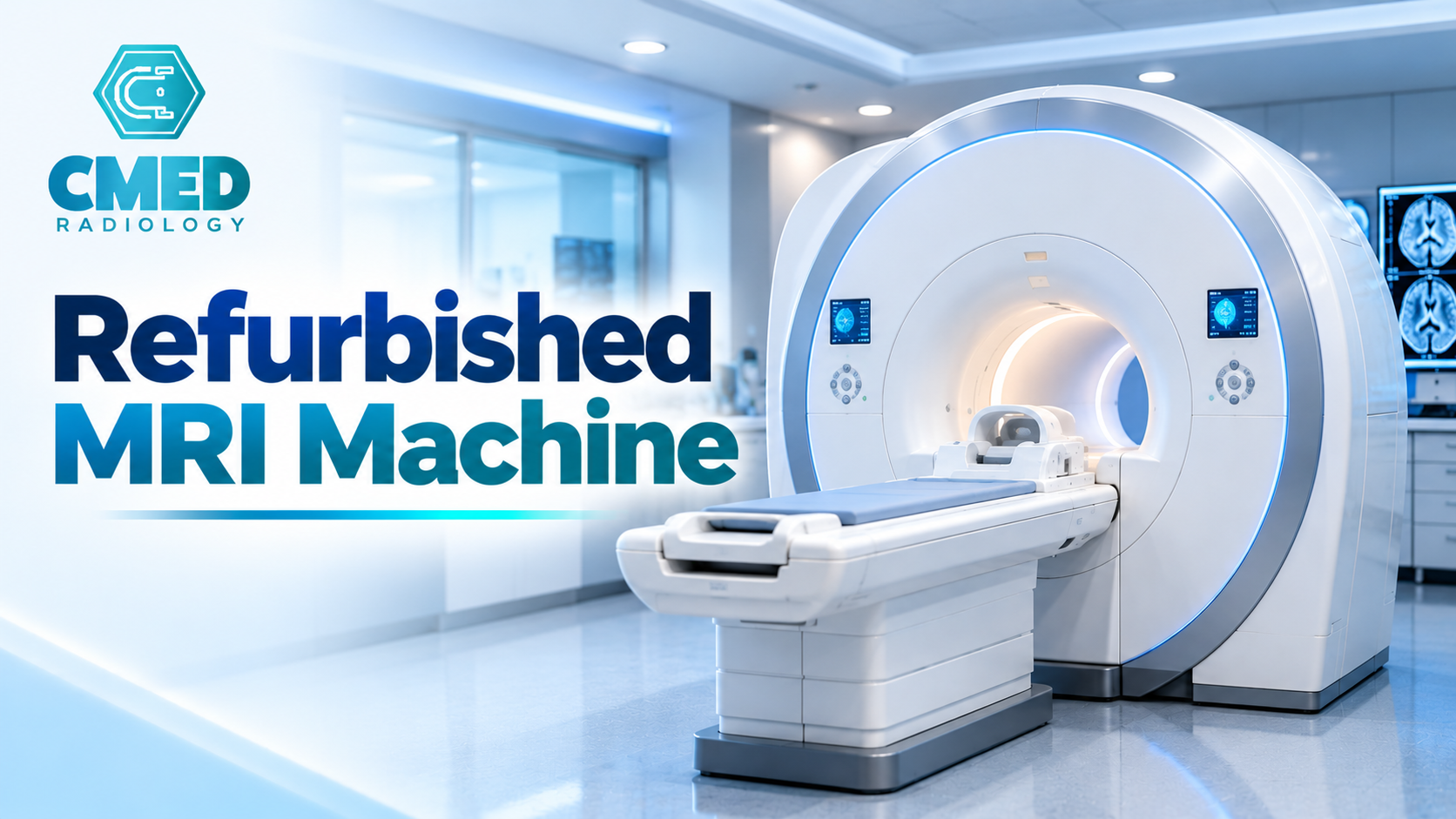
A Refurbished MRI Machine is a used magnetic resonance imaging machine that has been tested, cleaned, repaired, had equipment replaced and electronically tested. The extent of the refurbishment will be determined by the model, condition of the equipment and the work carried out by the service company.
Unlike equipment sold off-the-shelf with no restoration done, a professional reconditioned system will come with records of the work undertaken and of the tests carried out. Make sure you see them, rather than assume all refurbished scanners are equally well restored.
Why Is Quality Inspection Important?
Magnetic resonance imaging (MRI) systems rely on a number of different functions working together. Even if the scanner switches on and functions at a minimal level, there can still be issues with the imaging coils, gradient accuracy and performance, image processing, software and image uniformity.
Organized examination assists in exposing flaws, helps to define what can and can't be done to the equipment and determine if there's need for further repairs or testing before making it available for clinical use.
In Refurbished MRI Machine quality checks set the stage for future maintenance. With test results and service history recorded, engineers can assess how well the system is operating in comparison to when it was last checked.
1. Check the Magnet Condition and Stability
The main magnet is probably the most important piece of the MRI scanner. It produces the magnetic field that is necessary for imaging and the condition of the magnet affects the performance of the system.
It is essential to seek a technical inspection of the magnet and system to support the magnet for any Refurbished MRI Machine. The inspection should be suitable for that model and magnet design.
Important Magnet Checks
Magnetic field stability Validate the field within the specified manufacturer tolerances.
Field homogeneity: Is the magnetic field of appropriate homogeneity for the different imaging purposes.
For superconducting equipment, determine the pertinent cooling equipment, such as the cold head and the helium equipment. Service history checks past faults, repairs, and maintenance logs regarding any previous magnet. Safety considerations ensure the necessary magnet safety and site requirements have been fulfilled.
Any similar tests should be performed by a qualified MRI engineer, and the result should be written in a report. Any abnormal results should be investigated prior to the acceptance testing of the system.
2. Evaluate Image Quality and Imaging Performance
Image quality is a primary performance parameter as it indicates whether an MRI system is capable of providing clinically useful diagnostic information. Visual examination of the equipment alone does not determine the imaging performance. Refurbished MRI Machine must be tested for quality-control and performance-by utilizing appropriate techniques and existing equipment.
Important Image Quality Metrics
Signal-to-noise ratio: The amount of the meaningful image signal present in proportion to the amount of background noise present. Poor performance can make anatomical structures more difficult to differentiate.
Image homogeneity: Homogeneity test allows to detect unwanted variation in signal level across the image. This evaluation ensures the size and location of objects are correct.
Artefacts: Unwanted patterns or distortions can distort your image and make it more difficult to interpret. Testing should reveal what is causing these artefacts.
Spatial resolution: Refers to the systems capacity to differentiate between small objects at short distances apart.
Testing should be done in accordance with manufacturer's recommended procedures and accepted MRI quality assurance procedures. Record the results of your tests and ensure investigations are carried out for failed tests prior to patient use of the scanner.
3. Inspect Radiofrequency Coils
Radiofrequency (RF) coils transmit radiofrequency signals into the patient's body and are required to obtain MRI images. There are dedicated RF coils for head, spine, knee, shoulder, and other body parts. The coil condition will affect the image quality, the signal, and the types of examinations a diagnostic facility can perform.
What Should Be Tested?
The coil provided should be examined as well as functionally checked for the applications of the coil.
A Refurbished MRI Machine supplied with incomplete or incompatible coils may not support the full range of examinations expected by the facility. Therefore, buyers should obtain a written inventory of the included coils and test results.
4. Examine Gradient Systems and Mechanical Components
Gradient systems are used to spatially encode the MRI signal in Refurbished MRI Machine, allowing the scanner to know where in the body the image signals are coming from. This in turn affects the image creation process and acquisition time and the spatial integrity of the image.
The gradient functionality needs to be checked by a qualified engineer as specified by the system, with testing may include tests relevant to the functional performance, calibration, and image artefact.
For the mechanical components, which can have an impact on patient positioning and daily operations, take a look.
Patient Table and Moving Parts
Examine table, table-tilting device, bearing, drive drives and other details for accuracy. The table should run correctly with the maker's demanded features, other directions for movement and safety and security features.
Inspect cables, connectors, cooling fans, and other parts for signs of wear or damage. If items have been replaced in Refurbished MRI Machine, ask for documentation indicating what work was done.
Our details inspection and replacement of some of the mechanical parts, such as fans, bearings, table parts, and cables, as part of the refurbishment process.
5. Verify Software and Computer Systems
The use of a specific imaging sequence, reconstruction of the image, operation of the system and activation of specialised applications are all dependent on the MRI software. Additional computer hardware and compatible interfaces are used as well. The software version, applications and licenses should also be noted before purchasing a Refurbished MRI Machine.
Software and Compatibility Checklist
- Validate the scanner model and software version loaded.
- Ensure the provided imaging sequences work.
- Determine what specific apps are licensed & what is included.
- Verify availability of your replacement compatible computer parts.
- Confirm the facility's PACS/RIS connectivity if needed.
- Review data transfer and information-security requirements.
- Check that your configuration is compatible with upgrades.
Older hardware does not automatically mean that it can run everything.Hardware capabilities, licensing software and vendors' support may restrict the upgrade options.
With a written configuration report, the buyer will be able to assess the true capacity of the system, and will not be surprised by any additional costs after the system is installed.
6. Review the Refurbishment and Maintenance Records
This documentation is evidence of the condition of the equipment as it has been examined, repaired and serviced. It can be a useful indication of the previous working condition of the scanner. When inspecting a Refurbished MRI Machine, look for records about the work being done and do not just settle for word of mouth.
Documents Worth Requesting
Insufficient documentation isn't necessarily a sign of faulty equipment, but it is a red flag that needs to be resolved prior to acceptance. Also make clear if the price includes preventive maintenance, emergency services, spare parts and technical assistance.
7. Verify Calibration and Final Quality Testing
Calibration and final testing determine whether or not the Refurbished MRI Machine remains within the operating specifications after refurbishment and re-assembly. We indicated to us that their technicians calibrate and test components using the original equipment manufacturer's (OEM) specifications and service procedures. Ask your potential buyer for the original test reports of the system you are buying.
What Does Final Testing Involve?
At the discretion of the scanner and work performed, the final tests may include:
- Verification of system functions and operating controls.
- Assessment of relevant magnet and gradient performance.
- Testing of RF coils and signal acquisition.
- Image-quality testing using suitable phantoms.
- Verification of software functions and supported applications.
- Checks of patient-table movement and safety functions.
- Documentation of outstanding faults or limitations.
A Refurbished MRI Machine is not ready for clinical use just because the refurbishment has been done and completed. The unit's final test results are still to be checked and any issues that have not been sorted still to be dealt with. Acceptance criteria should be set in place ahead of delivery, so that both the supplier and the customer are aware of how to successively commission the end product.
8. Assess Installation and Site Readiness
Scheduling delays are inevitable if your healthcare center is not initially prepared, even when equipment is technically ready to go. MRI installation is a complex process that requires expert coordination and planning.
Prior to delivery, conduct a site assessment on the proposed location of the scanner room, access routes, structural requirements, power requirements, cooling requirements, ventilation requirements, shielding requirements and service access.
Key Install Considerations
Room and shielding:Space is required to house the scanner and equipment. The use of magnetic-field zone and RF shielding areas is mentioned within a professional design.
Electrical and cooling infrastructure: For accuracy, ensure the site must be able to handle specific scanner models and configurations.
Magnet handling: If superconducting (MRI) systems are purchased, then purchasing facilities and processes for magnet ramp, shimming, pre-cooling and helium work may be required.
System commissioning: Calibration, functional tests and acceptance tests are necessary.
Training: Staff should be trained in scanner operation, screening, safety and reporting faults.
A Refurbished MRI Machine is typically put into clinical use once installed, quality standards have been met and if appropriate any regulatory requirements have been fulfilled.
9. Confirm Patient Safety Requirements
During equipment assessment, installation and operation, patient safety should always be kept foremost. Since there are strong magnetic fields generated by the MRI scanner, they can have effects on external or implantable medical devices, and ferromagnetic items.
Just like any other MRI, a Refurbished MRI Machine is subject to the same MRI safety principles.
Essential Safety Measures
- Establish controlled access to restricted MRI areas.
- Screen patients and staff as directed by your facility.
- Verify MRI suitability and usage conditions of applicable implants and medical devices.
- Make sure that the emergency procedures are in place.
- To confirm that patient-table controls and safety functions are operating properly.
- Train personnel on the dangers of magnetic fields and equipment handling safety.
- Follow the operating instructions of the manufacturer, as well as all rules and regulations.
- Particular considerations should be given to patients with implants, metallic foreign objects, and medical devices in relation to MRI safety.
The equipment acceptance should be carried out by the relevant qualified persons such as MRI engineers and other clinical or technical staff as necessary.
10. Understand Warranty and Long-Term Service Support
Refurbishment quality is only one element of long-term equipment ownership. Operating continuity depends also on the maintenance regime, on spare parts availability and on whether engineers are available. Question the warranty and service policy of the seller before you agree to buy a Refurbished MRI Machine.
We offered by the provider include installation of the MRI, maintenance and repair services, spare parts and technical assistance. It is important to verify whether there is support provided for your system.
Conclusion
The process of establishing a used MRI's viability for installation should consist of: testing procedures, safety checks, clinical needs, and other logical considerations. Magnet stability, the quality of the images produced, RF coils, grade performance, software compatibility, mechanical functionality and service history can all be factors.
A refurbished MRI machine is designed to be well documented of the refurbishment works and testing performed. It should be checked out at the site with regard to site readiness and site installation, acceptance criteria, warranty, and the availability of service engineers.
CMED Radiology Private Limited refurbishment will encompass equipment selection, mechanical and electrical inspection, repair and replacement of components as required, calibration and testing for performance. Facilities may want to check out its refurbished MRI equipment information and its installation and maintenance services to see the sorts of things it does.
Above all, the most meaningful quality checks are those performed by qualified and documented experts. Performing quality checks in this way allows the healthcare team to establish the condition of the equipment, to flag up any areas of risk and to create a sound basis for safe, reliable diagnostic imaging.
Frequently Asked Questions (FAQs)
1. Which is the most critical quality check for used MRI equipment?
All of magnet testing, image-quality testing, coils, software, safety, and documented acceptance tests.
2. How is MRI image quality tested after refurbishment?
Tests such as signal-to-noise measurement, uniformity, geometric accuracy, spatial resolution and artefact tests may be performed. Appropriate phantom tests and tests recommended by the manufacturer to check performance may be employed.
3. What is the reason for testing all coils?
Various coils serve specific anatomical areas. Using a damaged or incompatible coil will impact image quality and in some cases not allow an examination to be performed properly.
4. Should magnet conditions be checked before installation?
Yes. The condition of the magnetic and the rest of the supporting systems should be assessed by experts. Superconducting systems might need further testing with cryo parts and facilities.
5. Does CMED Radiology provide MRI installation and maintenance services?
We had all the information on Refurbished MRI Machine's installation, technical maintenance, spare parts, and associated services listed on the company website. Inquire with the company to see what exact services and coverage they can provide for a particular equipment configuration.