Quick Enquiry

How Used Siemens MRI Systems Support Modern Healthcare
Magnetic resonance imaging is one of the key tools used in today's modern medical imaging to assist doctors in viewing internal organs and structures such as the muscles, soft tissue, joints, brain and spinal cord. For hospitals or diagnostic centres that are considering adding new imaging equipment, used MRI systems can be a useful solution when properly purchased, installed and maintained by a trained, professional service engineer.
Purchasing a Used Siemens MRI Machine is an option for a healthcare organization that needs proven MRI equipment and wants to conserve capital. But, there is more to the purchase process than price shopping or choosing one manufacturer or a model. Buyers need to evaluate the magnet, imaging quality, software configuration, service history, installation, and ongoing maintenance.
MRI systems. The capabilities of each version will differ, and therefore it is important to understand the needs of your clinical workload, as well as the intended use of the machine.
CMED Radiology Private Limited says that this company offers medical imaging equipment like MRI for sales, maintenance, refurbishment-related services, spare parts and technical support services. Further this page defines the process of refurbishment of equipment which includes equipment inspection, checking components, reassemblage, calibration and testing.
What Is a Used Siemens MRI Machine?
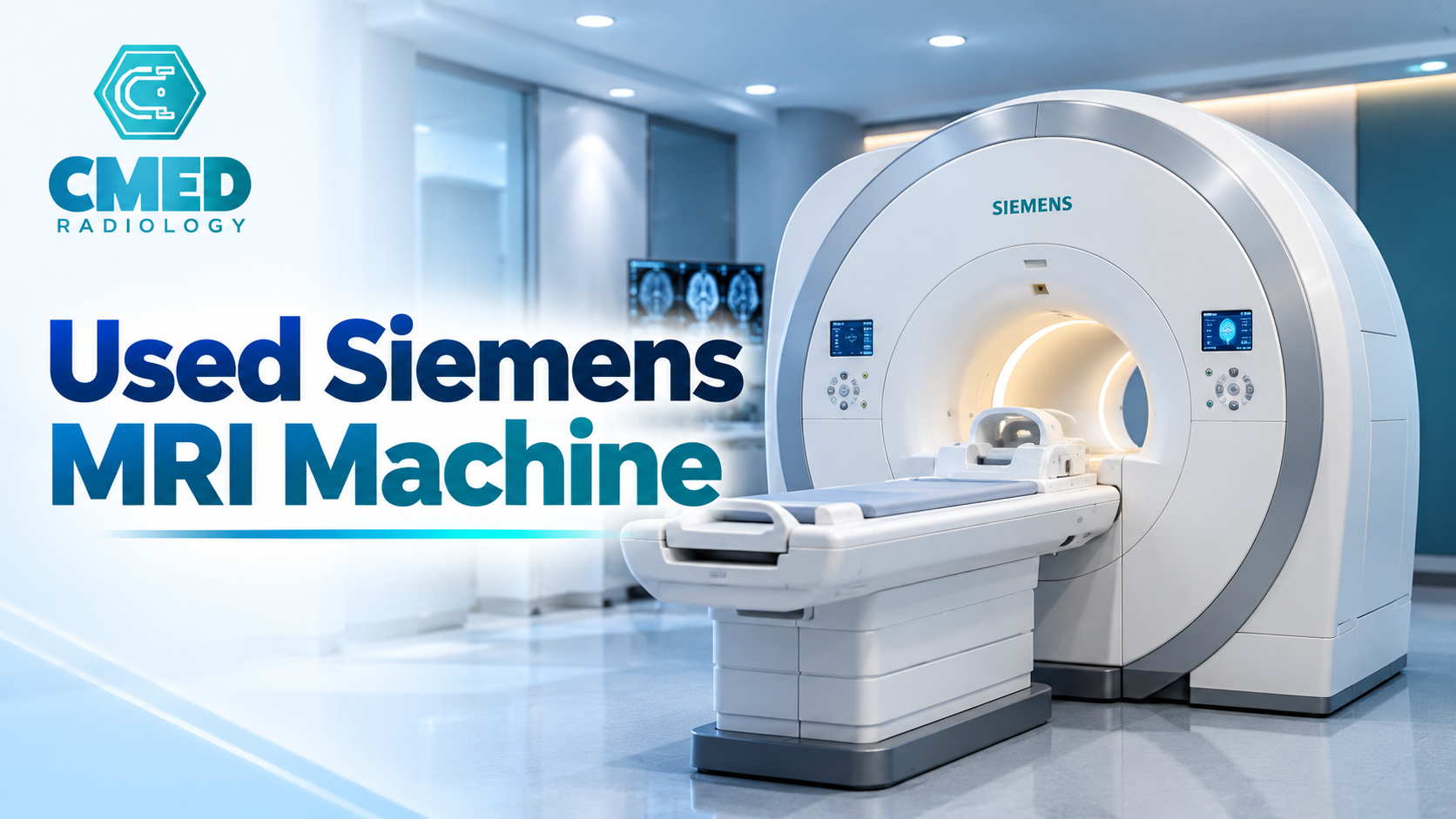
Used Siemens MRI Machine is a magneto-resistive imaging system that is previously used by a hospital or a diagnostic centre or any other health care centre. The used system is sometimes sold as it is or professionally refurbished depending on the mode of the seller.
The refurbished program normally covers Inspection, Defective worn parts are removed, Repairs, Check the system and quality tests, As to system, model, and system owner can be defined.
Know what's used and what is refurbished. A used system isn't necessarily a refurbished system, and terms like 'refurbished' don't necessarily mean the machine is a good match for the clinical, technical or even regulatory requirements.
How Does MRI Technology Work?
A Used Siemens MRI Machine takes detailed images of the inside of your body. The scan uses strong magnets, radiofrequency and a computer. It does not involve the use of ionising radiation.
Some of the parameters that affect the resolution of the image are Magnetic strength, imaging sequence, receiver coils, motion, system status, protocol. It is a fault or it passes siemens condition abnormal technicals or images for the ones currently being used.
Important Factors to Check Before Using the Equipment
Selecting pre-owned MRI equipment requires a structured evaluation. The following factors help hospitals and diagnostic centres make an informed decision.
1. Verify the Model and Technical Specifications
If you are buying a Used Siemens MRI Machine you should know what is the field strength of the MRI, Software, bore size and the imaging features. Check the manufacturing year, model, options, Software version before buying.
For instance, 1.5T of the system is sufficient for routine screening and all examinations, but 3T gives an advantage for specific applications where the improved signal-to-noise ratio is advantageous. But one field strength is not optimal for every patient or every examination.
Acknowledge the vendor with the manufacturing date (or serial number) of the original piece of equipment, and request the vendor supply the original equipment documentation, accessories, coils, software licence keys and optional upgrades.
2. Assess Magnet Condition and Stability
The Magnet is the most critical component of the MRI system. Its condition can impact system availability, operating costs and consistency in imaging performance.
When considering the purchase of a used Siemens MRI machine, ask for information regarding magnet condition, cryo-system status (if appropriate), faults and any major repairs. Have the appropriate systems checked by a qualified engineer and that the magnet is operating within the manufacturer's specifications.
Testing of the superconducting MRI system should possibly encompass: the cold head, systems associated with the helium, the vacuum system and any other specific areas identified with the particular model. These tests should be performed by suitably qualified persons.
3. Evaluate Imaging Performance
While a machine has successfully powered on it doesn't mean that it is ready for clinical use. Imaging performance needs to be checked prior to patient exams.
Ensure to cover the following technical aspects in your technical assessment: Image uniformity, Signal-to-noise performance, Geometric accuracy, Artefacts, Coil performance, and other quality control considerations. The acceptance tests should then be carried out according to the relevant manufacturer guidelines and the accepted standards of Used Siemens MRI Machine quality assurance practices.
Clinical application specialists and imaging professionals can assess whether the equipment is generating suitable images for planned examinations.
4. Review Software and System Compatibility
MRI software contributes to the details of image acquisition, image reconstruction, available sequences, workflow and connectivity to the hospital information system.
Identify the software version that is installed in the used Siemens MRI Machine, also the kind of applications enabled. Don't assume a used MRI machine has the capability for the newest software version.
Test the cross-compatibility of the unit with hospital information systems, including the field's Picture Archiving and Communication System (PACS), the facility's Radiology Information System (RIS) and any other document management and reporting systems. Determine what interfaces, licences, hardware or other technical work will be needed.
5. Examine Service and Maintenance Records
A detailed maintenance history informs buyers how the equipment has been used and maintained. Request for available information such as Preventive maintenance, major component replacement, reported faults, software revision and past down time information.
When possible cross check provided information with reports, service history, and equipment tags. A well recorded history of service history could help you spot risks and give you an idea of future servicing costs. An absence of historical records should not be seen as a defect as such, rather something to question.
1.5T vs 3T Siemens MRI Systems
Choosing between field strengths requires an understanding of the facility's clinical requirements, patient volume, available budget, and technical infrastructure.
3T systems also cannot guarantee improved diagnostic outcomes in every case. While the signal-to-noise ratio performance of a 3T system is much improved, there are other artefacts and technical issues that can arise. Thus, the right Used Siemens MRI Machine is the machine whose proven capabilities suit the service line, number and skills of staff, infrastructure, and budget of the facility.
Understanding the Refurbishment and Quality-Testing Process
Technique work should be documented and not just cleaned equipment or beautified surface. We explained a sequence of work performed on an imaging equipment to include equipment selection, quality assurance checks, mechanical and electrical inspection, replacement of parts, re-assembly, calibration, and performance testing. It must be verified that the work required on the individual system is completed as per its service documentation.
What Should a Refurbishment Assessment Include?
A comprehensive assessment may cover the following areas:
Mechanical inspection: the patient table, moving parts, covers, and cables. Visually inspection: service cover, visual part of the connectors and displays of the system.
Electrical and system testing: Testing the relevant electrical systems, computer systems, controls, and safety functions.
Magnet judgment: Examination of relevant magnet and cryogenic portions as appropriate.
Coil testing: Confirm that the receiver coils supplied are working correctly and suitable for the examinations to be performed.
Software & applications: Confirmation of software installed, activated features and supported imaging protocols.
Calibrations and image testing: Whole calibration, quality-control and image-performance tests were done.
Records: of the work carried out, test results, parts replaced and any unresolved restrictions.
Installation and Infrastructure Requirements
Used Siemens MRI Machine is for a specialised process that demands proper planning of the site and technical skills. A system that is perfectly maintained will also face issues operating if the venue is not properly equipped for it.
Room Planning and Magnetic SHIELDING
The site should be designed to include the location for the scanner, patient table, operator's console, accessories and services access. The site must consider access control regions of magnetic field, arrangement of accessories and services and shielding. The site must be professionally assessed before installation in order to determine requirements for structural support, magnetic shielding, air supply, cooling and other environmental factors for the particular system and building.
Electricity and Cooling
The electrical system and room must have the necessary infrastructure and environment control for the Used Siemens MRI Machine. Exact specifications vary by the model and configuration.
Certain other superconducting systems necessitate the deployment of specialised cryogenic systems and the inclusion of adequate helium-related safety facilities. These considerations should be reviewed by the installation team prior to delivery of the equipment to site.
Installation, Testing, and Staff Training
Install should include the needed mechanical assembly, system checks, calibration, acceptance testing, and image quality assurance. We used Siemens MRI Machine shifting, ramping and shimming, pre-cooling, helium filling, replacing the cold-head, and 1.5T and 3T installation. The services for a given project should be specified prior to ordering.
Staff should be trained in normal operation, emergency procedures, patient screening, handling of equipment and escalation of technical faults.
MRI Safety and Clinical Readiness
Patient safety is paramount whether the scanner is new, used or refurbished. A Siemens MRI Machine must not be put into clinical service until it has passed the required acceptance checks.
Patient Screening and Access Control
The space where MRI scans are done contains powerful magnetic fields that can be dangerous to patients and staff. Screening will be done before you go into the Used Siemens MRI Machine room. Come back to any implanted medical devices, metallic foreign body, external medical devices and any other contraindications. Assess each device according to the safety documentation. Access to sensitive MRI environments should be restricted and all staff should be aware of the dangers of ferromagnetic objects.
Quality Assurance Before Clinical Use
The user acceptance tests and safety tests and quality-control tests on the facility should be performed before patients are imaged. These tests should be performed by an MRI qualified engineer, a radiologist, medical physicist, and other individuals, as necessary, at the installation and in accordance with local regulations. Technical faults, unsafe acts or violations in clinical protocols are to be rectified prior to the scanner being used for patient scans.
Cost Factors and Long-Term Ownership
The price paid is just one element of an Used Siemens MRI Machine overall cost of ownership. So, a realistic budget must consider the cost of installation, room setup, servicing, energy requirements, staffing and parts replacement.
The Cost of a Used Siemens MRI Machine depends greatly on the model, field strength, whether you need the latest software, and the installation complexity. Instead of a free website online calculator, ask for a quote with an itemised price for the equipment without various other items such as warranty, maintenance, installation costs etc.
Common Mistakes to Avoid
Procurement is a worthwhile process only if it does not come with the following risks. A cheap purchase price may be short-changing the eventual costs of maintenance or installation.
Disregarding the service history: Without complete documentation, identifying past failures and repairs becomes more difficult.
Robotics assumes that all reconditioned systems are the same: Reconditioning & testing levels are different from supplier to supplier and machine to machine.
Ignoring software licences: Certain features that are advertised may need other licences to utilise (e.g. NBN).
Forgetting to do a site inspection: Infrastructure issues can result in delays and unbudgeted costs.
When purchasing they need to be sure what is covered, what isn't and exactly how the warranty works.
Launch of clinical activities too early: Execution of demanded safety testing and acceptance testing is mandatory.
A written assessment process aids better decision making and safeguards service continuity over time.
Why Technical Support Matters After Installation
Ongoing technical support is essential for the running of your MRI machine to ensure it performs to its specifications and to prevent unnecessary downtime. Access to engineers and spare parts can be critical if you are running a slightly older machine.
CMED Radiology Private Limited offers details on the maintenance, service, and installation of the MRI, as well as service options based on parts for each supported device, and maintenance services. For any model the provider has chosen, inquire as to its coverage, response times, what parts are accessible, and what is not.
Demand that the Used Siemens MRI Machine vendor states how they deal with technical faults and see if maintenance repairs are part of the deal.
Other long term planning considerations are: regular quality assurance, records and maintenance on equipment, staff training and the consideration of clinical needs on a regular basis.
Conclusion
When considering used MRI systems, there are tradeoffs in the ability, condition and safety of the system against the onsite infrastructure and long-term operating costs. A systematic consideration can give hospitals insight into whether a system is right for your patient's needs and scan volume.
Prior to the appointment of a Used Siemens MRI Machine, establish the Siemens MRI Machine model and details, ensure suitable usage, review or arrange refurbishing, discuss maintenance arrangements, and test image quality prior to the installation and acceptance tests. Procedures and maintenance plans for patient safety should be in place prior to clinical application.
The company sells a range of equipment and technical support service of maintenance and installation, etc., related to MRI. Hospitals or other healthcare facilities are contemplating a system that can make use of the information about MRI equipment and technical services of the company.
In the end, the proper choice is determined by documented equipment status, proven performance, open service contracts, and appropriate for the clinical needs of the facility- not a discounted price or brand name.
Frequently Asked Questions (FAQs)
1. Is installation complicated for a pre-owned Siemens MRI?
Yes. It depends on the Used Siemens MRI Machine model and installation site; planning of room, magnetic shielding, electrical and cooling requirements, handling, calibration and acceptance testing.
2. What maintenance is required after installation?
Maintenance could involve arrangements for Technical inspections per schedule system checks of the performance of equipment and coils checking of computer systems and software; servicing of relevant magnet and cooling components. Refer to the relevant manufacturer recommendations and service agreement.
3. Does CMED Radiology provide MRI installation and maintenance services?
For Used Siemens MRI Machine, we offer installation, moving, ramping and shimming, cryogenic-related services, cold-head change-outs and maintenance agreements for its website. Please get in touch with us to verify that you service your equipment and what coverage is available.
4. What documents should be collected prior to accepting the equipment?
Ask for the equipment identification and configuration records; any records of services, refurbishments, test records, software and licences, warranty records and installation records; and any safety and legal requirements.
5. When can the scanner begin clinical operation?
Once the Used Siemens MRI Machine has been erected, Acceptance testing, safety verification, quality control, staff training, and other applicable regulatory requirements have been satisfied and the system has been released for clinical use by those responsible.