Quick Enquiry

CT Scan Machine Guide Uses, Types and Key Advantages
Modern healthcare relies heavily on advanced diagnostic technology to detect diseases early and provide accurate treatment plans. One of the most significant innovations in medical imaging is the CT Scan Machine, a powerful diagnostic system that allows doctors to visualize internal organs, bones, blood vessels, and soft tissues with remarkable clarity.
A CT Scan Machine uses advanced computer processing combined with X-ray imaging to create cross-sectional images of the human body. These images help physicians diagnose conditions that may not be visible with traditional imaging methods. From detecting tumors to identifying internal injuries, this imaging technology plays a crucial role in modern medicine.
What is a CT Scan Machine?
A CT Scan Machine (Computed Tomography scanner) is a highly innovative medical imaging technology which takes a series of X-ray images of varying angles and then uses computer algorithms to construct detailed cross-sectional images.
This is contrary to the traditional X-ray systems which only give a single-layered image of organs and tissues, but this technology gives multi-layered images of organs and tissues and the doctors can analyze the structures with a lot of precision. Those cross-sectional images may also be built into 3D images so that they can be examined better in terms of diagnosis.
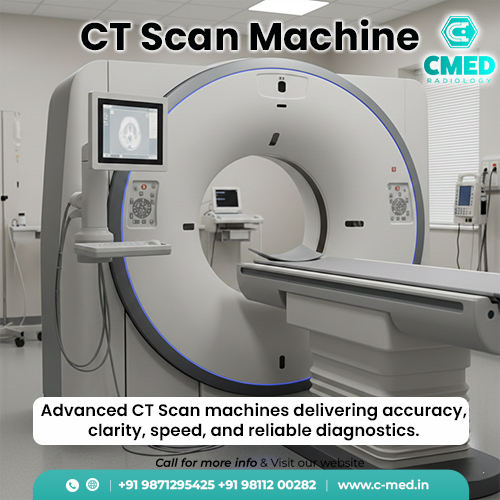
The equipment is composed of a rotating gantry, patient table, detectors and an effective computer system. In the scanning process, the patient is placed on a motorized table which passes through the scanner with an X-ray beam rotating around the body.
How a CT Scan Machine Works
The working principle behind a CT Scan Machine can be used to explain why it is such an effective machine in diagnosing complicated medical conditions.
1. X-Ray Generation
The system produces a controlled X-ray beam that penetrates through the body turning around the patient.
2. Image Detection
The X-ray signals pass through the tissues to detectors which are special.
3. Data Processing
The computer that is attached to the machine translates the signals into computerized data and forms them into detailed images.
4. Cross-Sectional Imaging
The processed data forms cross-sectional images (slices) of high precision of internal structures.
5. 3D Reconstruction
The combination of these slices can be done using advanced software to create three dimensional images that can be better diagnosed.
Main Components of a CT Scan Machine
The efficiency of a CT Scan Machine depends on several critical components working together.
Each component plays an essential role in ensuring accurate imaging and reliable diagnostic results.
Key Applications of CT Scan Machine
A CT Scan Machine is an instrument that is mostly used in different medical fields since it offers a detailed image.
1. Neurological Imaging
This technology is applied by doctors to identify brain tumors, bleeding, stroke and neurological disorders.
2. Trauma Assessment
Emergency departments are dependent on CT scans to detect internal injuries in case of accidents.
3. Cancer Detection
The machine assists in the identification of tumors, tracking of cancer and in facilitating treatment planning.
4. Cardiovascular Imaging
It enables people to see blood vessels and diagnose anything associated with the heart.
5. Lung Disease Diagnosis
CT scan is crucial in the detection of infection, nodule in lungs, and chronic lung malady.
6. Bone and Joint Evaluation
CT is a procedure that is conducted by orthopedic specialists to examine complex fractures and joint abnormalities.
Advantages of CT Scan Machine in Healthcare
The popularity of a CT Scan Machine is explained by the fact that it has many advantages in clinical diagnostics.
High Diagnostic Accuracy
CT scans give detailed images which enable the doctors to identify the diseases at their initial stages.
Fast Imaging Process
The majority of the scans can only last a few minutes and therefore can prove helpful in case of an emergency.
Non-Invasive Diagnosis
Image procedure does not necessitate surgery or invasive intervention.
3D Imaging Capability
The technology generates 3D images of high resolutions to improve clinical analysis.
Wide Medical Applications
CT imaging has its uses in oncology, cardiology among other fields of medicine.
Types of CT Scan Machines
Healthcare facilities may use different types of CT Scan Machine systems depending on their diagnostic needs.
Choosing the right imaging system depends on hospital requirements, patient volume, and diagnostic applications.
Why Diagnostic Centers Need Advanced CT Scan Machines
The healthcare facilities have been relying on the high imaging technology to provide the right diagnosis and enhance patient outcomes.
A high-tech CT Scan Machine will help physicians detect illnesses sooner, process more efficiently, and track patient progress more accurately. The scanners also have the advantage of reducing the scanning time, making scanning more patient friendly and also improving the quality of images provided by modern scanners.
Such companies as CMED Radiology Private Limited assist diagnostic centers to have quality imaging systems which are reliably designed to perform effectively and last long.
Safety Considerations in CT Imaging
Although CT scan is very useful, safety precautions should be well taken to reduce the radiation.
Radiation Control
The modern machines are fitted with superior dose-reduction technologies to ensure that the levels of radiation are maintained at low levels.
Professional Operation
The equipment must only be used by trained radiology professionals to develop safe imaging procedures.
Patient Screening
Before a doctor recommends a scan to a patient, he will need to determine whether the scan is needed.
Protective Protocols
When scanning, hospitals are under strict rules as to how to ensure the safety of the patients and the medical staff.
When handled with reasonable safety measures, the disadvantages of a CT Scan Machine are greatly underestimated as compared to the advantages.
Factors to Consider When Choosing a CT Scan Machine
Hospitals and diagnostic centers must evaluate several factors when investing in imaging equipment.
Selecting the right system ensures healthcare providers can deliver high-quality diagnostic services.
Role of CT Scan Machine in Modern Diagnostics
Medical imaging has revolutionized the manner of diagnosing and treatment of diseases. The CT Scan Machine has become the mainstay of contemporary healthcare because it can be used to show the internal body structures within a short time span and with high accuracy.
CT imaging assists doctors to make sound clinical decisions in emergency cases of trauma as well as during routine diagnostic cases. The quality of the images produced is highly detailed allowing the specialists to detect the abnormalities that might not be detected using other forms of imaging.
CT scanners are getting faster, safer and more precise with the current development of technology. Clinicians who invest in contemporary imaging systems have the potential to promote diagnosis and patient morbidity and mortality by a large margin.
Future of CT Scan Technology
The future of CT imaging is bright as various innovations are being used to further improve the diagnostic capabilities.
Artificial Intelligence Implementation
CT systems are being incorporated with AI algorithms to aid in the analysis of images and detection of disease.
Lower Radiation Imaging
The next generation scanners are made to reduce the radiation exposure, yet provide high quality images.
Faster Scanning Systems
Developed hardware ensures more rapid scanning rates which means less discomfort to the patient.
Improved 3D Imaging
Advanced reconstruction technology will give better anatomy visualization.
These will add more weight to the value of CT Scan Machine in the contemporary medical diagnosis.
Conclusion
CT Scan Machine is among the very crucial diagnostic tools in contemporary healthcare. The fact that it produces extremely detailed cross-sectional images assists physicians in identifying diseases, assessing injuries, and strategizing treatment with extremely high precision.
With the further development of medical imaging technology, the CT scanners are becoming efficient, safer and more powerful. Medical practitioners should invest in sound imaging equipment in order to provide high quality diagnostic services to patients.
The role of such organizations as CMED Radiology Private Limited is significant in contributing to the support of hospitals and diagnostic centers: the company offers high-level medical imaging equipment, which can match the requirements of the modern healthcare environment.
Having played such a significant role in the process of diagnostics, the CT Scan Machine will remain a part of medical imaging in the years to come.
Frequently Asked Questions (FAQ)
1. What is a CT Scan used for?
A CT Scan Machine is used to produce detailed images of internal organs, bones, blood vessels, and tissues to help doctors diagnose medical conditions accurately.
2. How long does a CT scan take?
Most scans performed using a CT Scan take between 5 and 30 minutes depending on the type of examination.
3. Is CT scanning safe?
Yes, CT imaging is generally safe when performed under medical supervision. Modern scanners use controlled radiation doses and advanced safety protocols.
4. What conditions can be diagnosed with CT scans?
Doctors use a CT Scan to detect tumors, internal bleeding, infections, bone fractures, cardiovascular diseases, and many other conditions.
5. Do patients need special preparation before a CT scan?
Preparation depends on the type of scan. Some procedures may require fasting or the use of contrast material for better imaging results.