Quick Enquiry

High Quality 3.0T MRI Machine for Modern Healthcare Needs
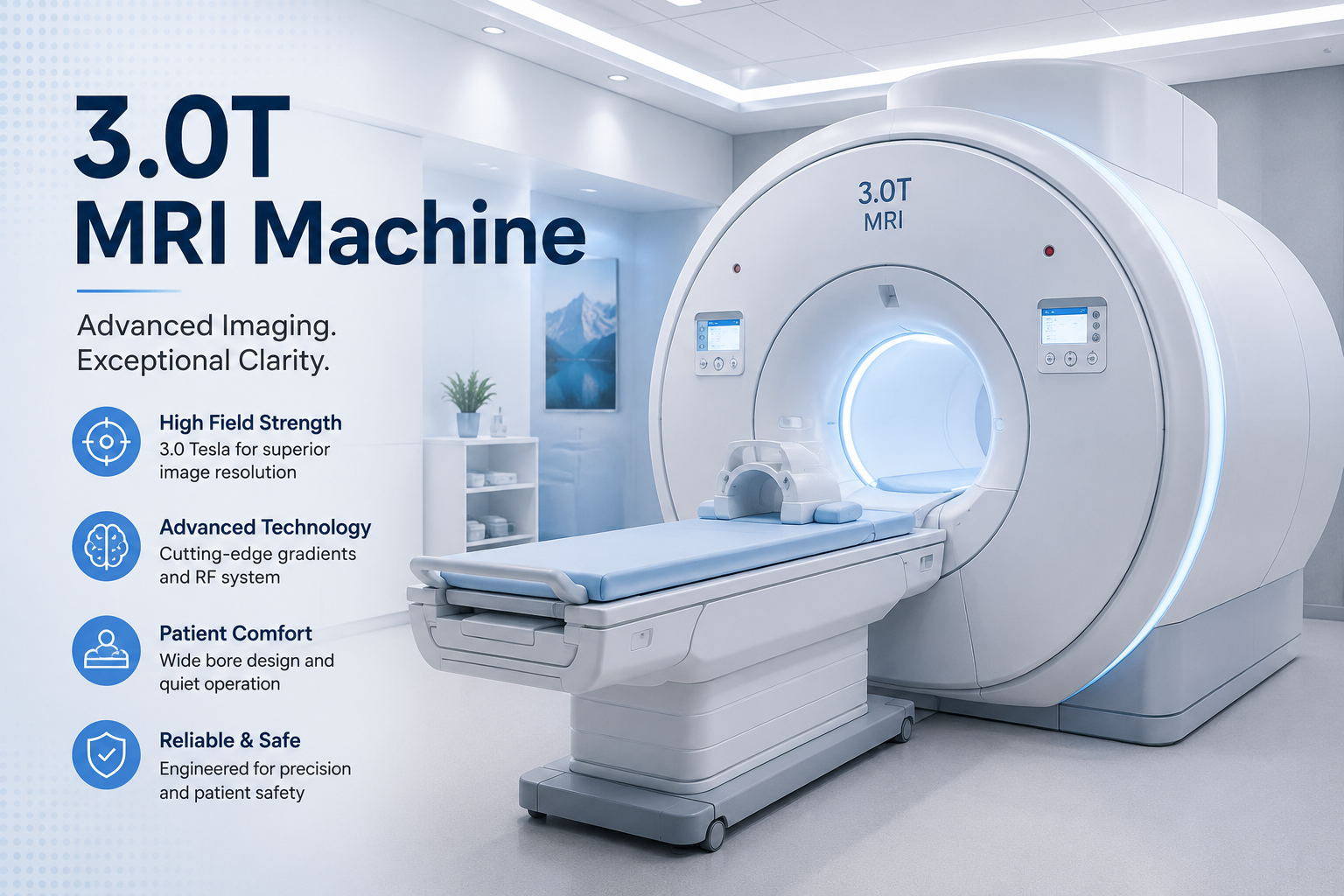
The contemporary healthcare system demands the application of advanced diagnostic devices that are capable of giving accurate findings in less time. One of the hottest medical imaging innovations in a hospital, research center, or diagnostic facility is the 3.0T MRI Machine. The technology assists the physicians to diagnose the diseases more precisely with a higher strength of magnetic field, better image quality, and scan speed.
Medical practitioners in the current world need imaging systems that are able to provide credible reports as well as enhance workflow and patient comfort. An expensive imaging system can assist doctors in identifying neurological diseases, orthopedic, cardiovascular, and soft tissue anomalies at an early stage. It is here that the 3.0T MRI Machine will have a significant role in contemporary healthcare services.
Importance of 3.0T MRI Machine in Advanced Diagnostics
Medical imaging technology has evolved rather rapidly. The traditional imaging system only offered a minimum amount of information and slower processing, but the new magnetic resonance imaging systems have transformed the diagnostics. A 3.0T MRI Machine offers more signal strength, and this enables doctors to have a high level of detail in the internal body structures.
This is a sophisticated system and is commonly applied in the diagnosis of complicated medical diseases. Neurologists use it to examine brain tissues and detect tumours, strokes, and nerve diseases. Orthopedic specialists use it in determining the joints, muscles, and spinal conditions. Improved imaging also helps cardiologists to examine the structures of the heart and the blood flow patterns.
The increased visualization of the image helps doctors to visualize even tiny anomalies that would be unseen in weaker imaging systems. Such a degree of accuracy helps in better diagnosis and improved treatment planning.
Features That Make the 3.0T MRI Machine Highly Effective
High-tech imaging systems are high-performing and are reliable, which explains why healthcare facilities invest in these systems. This imaging technology has been used in modern medicine in a very effective manner because of the following characteristics.
3.0T MRI machine- high-resolution imaging
Among the largest benefits of a 3.0T MRI Machine is that it gives high-resolution images. The magnetic field is more powerful and enhances the clarity of the images and increases the visibility of tissues, organs, and blood vessels.
Imaging is elaborate and helps clinicians in making the right clinical decisions. It is especially useful in neurological studies, musculoskeletal studies, and/or in vascular imaging studies where precision is critical.
Reduced Scan time and workflow
The second important benefit of advanced imaging systems is a short scan time. Quick imaging saves time and pain for patients, as well as improves working conditions in hospitals.
Short scanning periods are specifically beneficial with older patients, children, and those who might not be able to sit through long procedures. An effective scan can also help the hospitals to serve more patients within a day.
Enhanced Patient Comfort
The modern imaging equipment is not only focused on accuracy but also on patient experience. The advanced systems have many of the openings, less noise, and superior positioning of the patient.
There are comfortable scanning conditions that minimize anxiety and assist in the cooperation of patients during scanning. This is beneficial in improving the image quality and diagnostic processes.
Better Functional Imaging Capabilities
There has been an increased use of functional imaging in healthcare. A 3.0T MRI Machine facilitates more modern uses like functional brain imaging, spectroscopy, and diffusion imaging.
These functions can help physicians to learn how the organs work and how to detect abnormalities more efficiently. These technologies are also used in medical research and clinical development by researchers.
Applications of 3.0T MRI Machine in Healthcare
The use of advanced imaging systems, 3.0T MRI Machine applies in diverse specialties in medicine. They are multifunctional and are therefore highly essential to modern-day healthcare facilities.
Brain Imaging and Neurology
Brain imaging should be of superior quality because neurological diseases can be difficult to diagnose. The advanced imaging helps the physicians to inspect the brain structures in a very close manner and identify the presence of abnormalities such as tumors, epilepsy, strokes, and multiple sclerosis.
Functional brain research could also be facilitated using high-end imaging technology to help the experts to determine the neural pathways and brain activity.
Musculoskeletal/Orthopedic Imaging
The orthopedic specialists use appropriate imaging to examine the bones, ligaments, muscles, and joints. State-of-the-art imaging systems can be used to diagnose sports injuries, spinal disorders, arthritis, and tissue damage.
Detailed scans help the surgeons in planning medical interventions and to follow-up recovery following medical interventions.
Cardiovascular Diagnostics
The imaging of heart diseases is an elaborate procedure to identify blood vessels, heart tissues, and blood flow. The present MRI equipment can help cardiologists to evaluate the congenital heart diseases, vascular conditions, and cardiac performance.
Early diagnosis helps in medical intervention and enhances patient outcomes.
Oncology and Cancer Diagnosis
Cancer is normally diagnosed through precise imaging and to monitor the progression of the disease. The abnormal tumours and the surrounding tissues can be detected using state-of-the-art imaging systems and evaluated by the physicians.
Treatment planning and monitoring of therapy are also aided by high-quality imaging.
Benefits of 3.0T MRI Machine for Hospitals and Diagnostic Centers
The healthcare facilities are in need of imaging systems that enhance clinical performance and operational efficiency. State-of-the-art 3.0T MRI Machine systems have a number of benefits, which ease the work of medical practitioners and patients.
Improved Diagnostic Accuracy
Accurate diagnosis is one of the most important aspects of medical treatment. The rich imaging enables the physicians to diagnose diseases at an early age, reducing the possibilities of false diagnoses.
Increased Operational Efficiency
The increased number of patients can be processed in hospitals due to the accelerated scanning and an effective workflow. This helps in the better use of resources and improvement of healthcare delivery.
Better Patient Satisfaction
Patient comfort is becoming an important issue in patient care. The painless scans will improve patient satisfaction and speed up diagnostic tests.
Support for Research and Innovation
One of the ingredients in contemporary medical research is enhanced imaging technologies. Clinical studies and innovation in high-end imaging systems are applied in universities, research centers, and special hospitals.
Comparison Table of Advanced MRI Imaging Features
Role of Technology in Modern Imaging Systems
Diagnostic imaging is still enhanced through technological innovation. The field of healthcare is evolving through artificial intelligence, automation, and integration of the digital world.
The new imaging systems have come up with new advanced software to improve image processing and analysis. Automated workflows enable radiologists to easily view scans and reduce reporting time.
Digital integration and cloud-based storage also add to safe data management and easy access to medical records. Such innovations assist medical practitioners to offer quicker and more efficient services.
Why Healthcare Facilities Prefer Advanced MRI Solutions
Healthcare providers are focused on imaging systems that are accurate, efficient, and cost-effective in the long run. The 3.0T MRI machine would meet these requirements by offering high-quality features for diagnosis in many medical applications.
Hospitals and diagnostic centers often choose high-performance imaging systems because it is possible to improve the quality of services and gain clinical confidence. Multidisciplinary healthcare teams are also supported with advanced imaging, which can give appropriate information to make a treatment plan.
The growing concerns of preventive care and timely diagnosis of ailments have also augmented the demand for quality diagnostic equipment in the globe.
Factors to Consider Before Choosing an MRI System
One of the most significant healthcare-institution decisions is the imaging equipment. Before investing in a high-level 3.0T MRI Machine, there are a few factors that are to be taken into consideration.
Imaging Quality
The diagnostic accuracy is directly related to image clarity and resolution. The health professionals should choose those systems that offer reliable and full imaging results.
Patient Comfort Features
Patient cooperation in scanning is enhanced by comfort-oriented designs. Other features, such as larger bores and less noise, are beneficial in improving patient experience.
Workflow Efficiency
The hospitals require systems that will provide effective workflow and patient throughput. The shorter scan time assists healthcare facilities in becoming more productive.
Maintenance and Technical Support
Regular maintenance and technical support are needed to ensure ongoing functioning. The medical care providers should select imaging systems that have good services.
Future Scalability
Medical technology is ever-changing. Healthcare facilities are able to choose scalable systems to ensure that future needs can be met by scaling up the capabilities.
Emerging Trends in MRI Technology
The medical industry is dynamic, and imaging is no exception. MRI systems of the future will be even smarter, faster, and patient-friendly.
Future of Diagnostic Imaging in Healthcare
Advanced imaging technologies will continue to be important in the future of healthcare. The prevention of health care, individual treatment, and early diagnosis have become the key priorities worldwide.
A more sophisticated 3.0T MRI Machine will probably be more connected with artificial intelligence and digital healthcare applications. This integration can improve the clinical decision-making process and patient management.
The healthcare providers are becoming more and more invested in technologies that may improve efficiency, minimize diagnostic errors, and improve patient outcomes. Advanced imaging systems will continue to be critical to the realization of these objectives.
Conclusion
The existing healthcare demands effective, convenient, and accurate diagnostic solutions. The 3.0T MRI Machine has played an indispensable role in modern medical imaging due to its high-quality image, high speed of scanning, and broad clinical applications.
Neurology to cardiology and oncology to orthopedic care; the latest imaging technology assists the physicians in making the correct diagnosis and creating effective remedies. The benefits of the workflow include increased patient satisfaction, increased operational efficiency, and enhanced workflow in hospitals and diagnostic centers.
With the further development of healthcare technology, the advanced imaging system will be even more beneficial in enhancing the medical services and patient outcomes. Organizations such as CMED Radiology Private Limited are contributing to the development of diagnostic healthcare by aiding in the supply of contemporary solutions for imaging.
FAQs
Q1. What is the main advantage of advanced MRI technology?
It provides highly detailed imaging for accurate medical diagnosis and treatment planning.
Q2. Is MRI scanning safe for patients?
MRI procedures are generally safe because they do not use ionizing radiation.
Q3. Which medical fields commonly use the 3.0T MRI Machine?
Neurology, orthopedics, cardiology, and oncology frequently use this imaging system.
Q4. How does faster scanning help healthcare facilities?
It improves patient flow and allows hospitals to manage more appointments efficiently.
Q5. Why is image quality important in diagnostics?
Clear imaging helps doctors identify diseases early and create effective treatment plans.